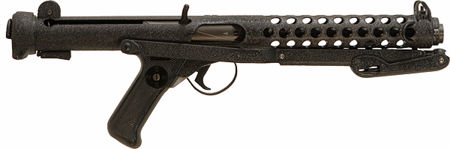
Its claim to fame: it was the model rifle used for the E-11 props in the original Star Wars movies, as well as for the Rebel handgun/carbines used in the opening scenes of A New Hope.

 by Turquoise Dragon on Sun Nov 07, 2010 11:41 pm

by Turquoise Dragon on Mon Nov 08, 2010 8:45 am

by Max Rambone on Mon Nov 08, 2010 8:49 am
It is a common misconception[3] that an individual must have a "Class 3 License" in order to own NFA firearms. An FFL is required as a prerequisite to become a Special Occupation Taxpayer (SOT): Class 1 importer, Class 2 manufacturer or Class 3 dealer in NFA firearms, not an individual owner. Legal possession of an NFA firearm by an individual requires transfer of registration within the NFA registry. An individual owner does not need to be an NFA dealer to buy Title II firearms. The sale and purchase of NFA firearms is, however, heavily taxed and regulated, as follows:
All NFA items must be registered with the Bureau of Alcohol, Tobacco, Firearms, and Explosives (ATF). Private owners wishing to purchase an NFA item must obtain approval from the ATF, obtain a signature from the Chief Law Enforcement Officer (CLEO) who is the county sheriff or city or town chief of police (not necessarily permission), pass an extensive background check to include submitting a photograph and finger prints, fully register the firearm, receive ATF written permission before moving the firearm across state lines, and pay a tax. The request to transfer ownership of an NFA item is made on an ATF Form 4.[4] Many times law enforcement officers will not sign the NFA documents. There have been several unfavorable lawsuits where plaintiffs have been denied NFA approval for a transfer. These lawsuit include; Lomont v O'Neil 2002 9th circuit, Westfall v Miller 1996 5th circuit, and Steele v National Firearms Branch 1985 11th circuit. In response Tennessee and Alaska have passed state laws which require the CLEO to execute the NFA documents.
The domestic manufacture of new machine guns that civilians could purchase was effectively banned by language in the Firearm Owners Protection Act of 1986 (also known as "McClure-Volkmer"). The language was added in an amendment from William J. Hughes and referred to as the Hughes Amendment.[9] Machine guns legally registered prior to the date of enactment (i.e. May 1986) are still legal for possession by and transfer among civilians where permitted by state law. The static and relatively small number of transferable machine guns has caused their price to rise, often over $10,000, although transferable Mac-10 and Mac-11 submachine guns can still be purchased for around $3,500. Machine guns manufactured after the FOPA's enactment can be sold only to law enforcement and government agencies, exported, or held as inventory or "dealer samples" by licensed manufacturers and dealers. Machine guns made after 1986 for law enforcement but not transferable to civilian registration are usually priced only a few hundred dollars more than their semi-automatic counterparts, whereas a pre-Hughes Amendment registered machine gun that can be legally transferred commands a huge premium.
Eventus stultorum magister.

Users browsing this forum: No registered users and 2 guests